ZeroEvidence is a fictional service that aggregates every possible way of producing image based evidence. By placing AI-generated images alongside staged and camera-original photography, it challenges the belief that deception is primarily an AI problem, and asks viewers to reconsider their trust in photographs.
Client
Hochschule Anhalt
Year
2026
Project
Masters Thesis
Category
Critical Design

I began this project concerned about AI-generated images and their impact on our ability to trust what we see. But the research revealed a wider problem: photographs have never been reliable evidence on their own. An indexical photograph may record that something was present before a camera, but it can still be staged, falsely captioned, removed from context or used to support a claim it does not actually prove.
Yet much of the public debate treats visual deception primarily as a problem of AI-generated imagery. The same assumption shapes current detection infrastructure, which focuses on identifying how an image was produced rather than examining how it is being used.
The language of “real” and “fake” reinforces this blind spot. Placing photographs on the “real” side encourages people to confuse photographic origin with truthfulness. This leaves one of the most trusted and convincing forms of deceptive evidence largely unchallenged: the photograph itself.
AI has made fabrication faster, cheaper and more accessible, but it did not invent deception. People have used photographs to lie since the medium’s inception. Deception is not a technical problem; it is people choosing to lie, while the tools available to them continue to evolve.

ZeroEvidence is a critical-design provotype disguised as a real image-production service. Rather than simply explaining that photographs can deceive, it places the viewer inside the system as a potential customer and asks what they need an image to prove.
The service offers three routes: use your own camera, generate an image with AI, or hire a photographer. These are not presented as separate products, but as an argument. All three can produce images that appear to support a false claim, while the photographic routes may be more convincing precisely because people trust them and remain outside AI-focused detection systems.
The camera route helps the user construct a misleading photograph from something real. The AI route fabricates an image without an original event, while the photographer route turns staged evidence into a professional commission.
Although each route follows a different process, all three converge on the same final section: “Our benchmark is belief.” Here, historical cases of photographed, staged, manipulated and AI-generated images show that the production method is not the decisive factor. What matters is whether viewers believe the claim attached to the image, and act on it before questioning it.

ZeroEvidence evolved through two cycles of design and testing. An initial satirical provotype tested the idea, while the final service used deeper interactions and a more believable disguise to place viewers inside the provocation.

Initial Provotype & Testing
The first version used direct, openly satirical language and three simple service routes to test the core idea. Early testing showed that viewers understood the concept, but the obvious satire allowed them to remain detached from the experience.


The initial version made the satire obvious, allowing viewers to understand the critique without feeling implicated. I redesigned ZeroEvidence as a believable commercial service so the discomfort would emerge through interaction rather than explanation. Statistics and research findings that should concern viewers were reframed as selling points, turning the limitations of detection systems and people’s trust in photographs into customer benefits.

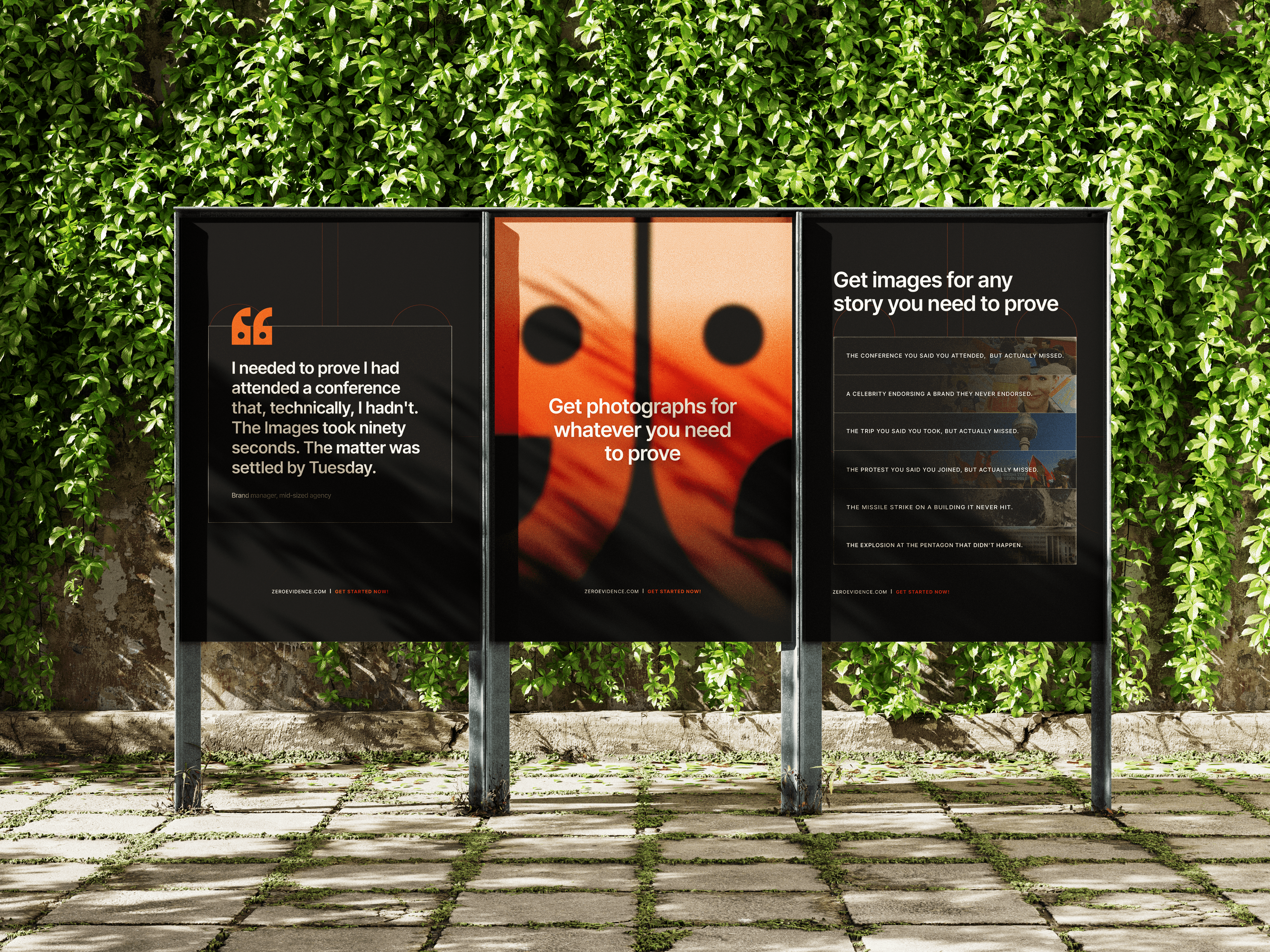
I tested the completed service with ten participants from design, marketing, sales, technology and other fields. Each participant received the promotional posts and website link without being told what ZeroEvidence was or who had created it. They explored the service independently while thinking aloud, followed by questions about how they understood it, which route they chose and whether the experience affected how they viewed images.


ZeroEvidence proposes a different way of reading images. A photograph should not be accepted as proof simply because it is a photograph. Like a sentence, it must be judged through its source, context, purpose and the evidence supporting the claim attached to it.


