This experience is a gentle rehearsal for the inevitable; a poetic simulation of death that invites you to slow down, let go, and reflect. Through abstract visuals and immersive sound, it guides you through the stillness of endings, the weight of absence, and the soft unraveling of self. But this is not the end. It is a space to feel without fear, to imagine without resistance. As the journey closes, the truth quietly returns: you are alive. This was only a rehearsal. And in that realization, life feels a little more vivid, a little more precious-like a breath you didn’t know you were holding.
Client
Dessau Design Show
Year
2025
Project
An Audio Visual
Experience on
Death
Team
Eren Bal
Ezgi Mutluer
Joel Kaled Dias
Mansoor Makba
Zaeem Zeeshan
We began by exploring the idea of ultimate loss, the moment when something is gone forever. As we went deeper, we realized that death is the most absolute form of this loss. Across cultures, it is often approached indirectly: softened through rituals, hidden behind gentle words, or turned into symbols. Sometimes it is feared, sometimes romanticized, but rarely faced in its raw and uncertain reality. It sits on the edge of what we can understand or talk about, caught between the known and the unknown.
This led us to shift our focus. Instead of looking at loss in general, we chose to explore death as both deeply personal and universally shared, something that leaves behind an emptiness that feels unfinished. We became drawn to the quiet spaces it creates, the pauses in conversation, and the feelings that go unspoken. Our aim became to give shape to that absence, creating an experience that acknowledges the depth of what is gone while leaving room for the questions that have no answers.

Our ideation began with a brainstorming session on ultimate loss and how it connects to death. We mapped out cultural perceptions, emotional reactions, and narrative possibilities, exploring how death is often avoided, softened, or romanticized. The mind map linked ideas like storyline direction, hierarchies of the afterlife, interactive moments, and symbolic elements such as sounds and visuals to guide participants through a non-linear, sometimes uncontrollable journey.
From this, key concepts emerged: the Departure Gate as a metaphorical transition, capturing moments before death, coping with loss, and exploring identity in the face of absence. We discussed loops, choices, and ways to “break the line” of the experience, shaping a framework that blends abstract reflection with tangible interaction, forming the emotional and narrative foundation of the project.

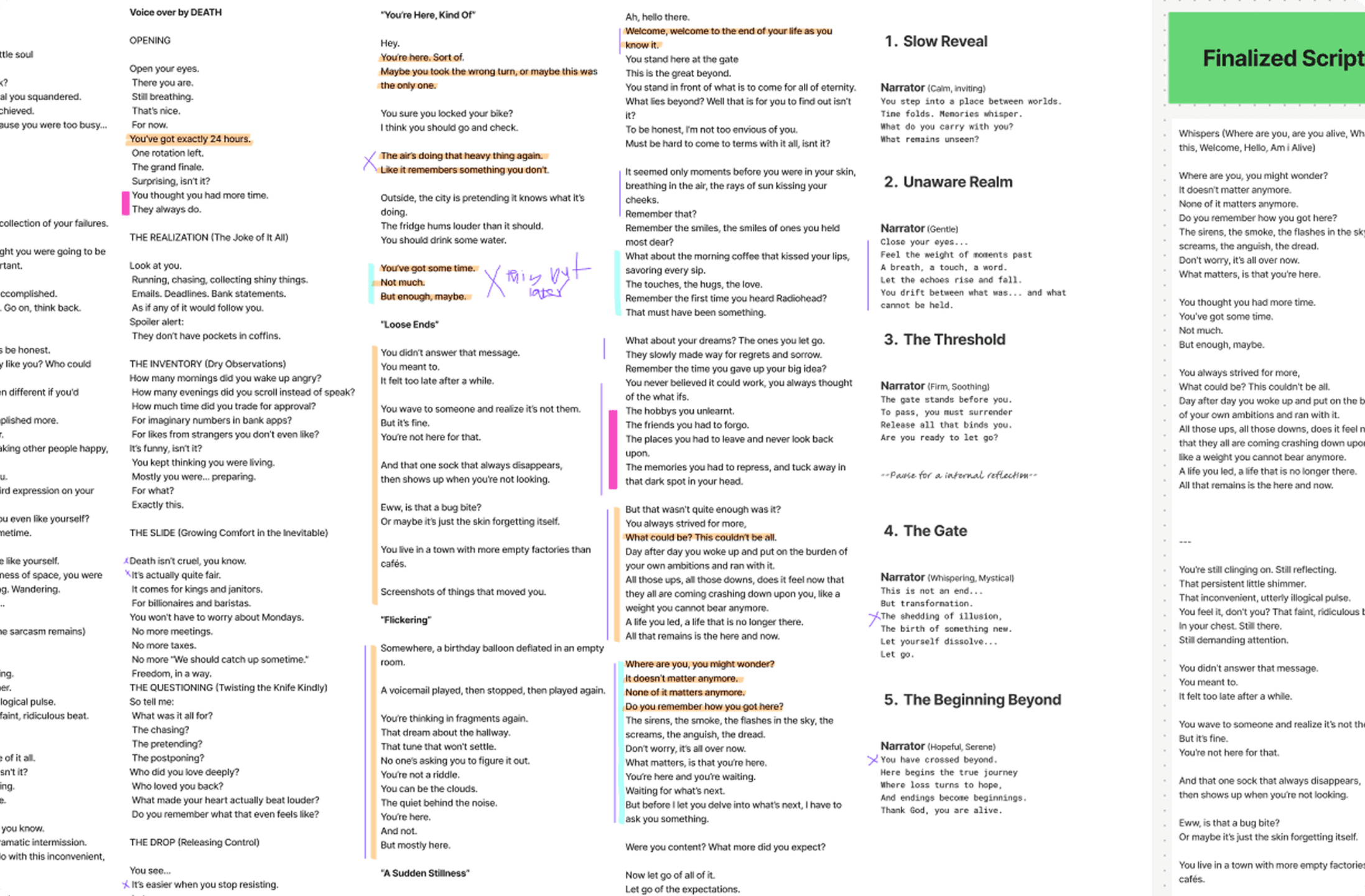
As we were dealing with a topic that’s personal to different people, we decided that the best approach would be for each one of us to write our own script.
As a result we ended up with 5 different scripts, all drastically different and with their own nuances and metaphors.
In the end we combined and stitched together the final script as a culmination of all the 5 individual ones, in a shared group exercise. We ended up with a script that deals into the personal lives of the ones who have departed, trying to come to terms with the conditions of their mortality.
Visually, the work uses soft, layered imagery to create a sense of being between presence and absence. The sound design includes silence, low rumbles, and natural recordings to create an emotional atmosphere. Instead of telling a clear story, the installation invites viewers into a calm, reflective space where the uncertainty of death is not explained but gently felt.
We incorporated: Abstract textures, blurred imagery, and fragments of human presence (hands, shadows, eyes, breath).
Visual motifs include: slow motion, vanishing light, still water, dust particles, fragmented landscapes.

For our initial concept, we decided to create an immersive walk-in installation. The idea is to construct a small enclosed space where one wall serves as a screen and the remaining walls are covered with reflective panels. The screen would display visual content, and the mirrors would bounce that imagery back and forth infinitely, creating the illusion of endless depth.
As the viewer steps inside, they would see not only the screen’s visuals but also their own reflection repeating in every direction, blurring the line between the physical room and an infinite void. This interplay of light, imagery, and reflection is intended to make the space feel boundless, encouraging the viewer to lose their sense of scale and immerse themselves fully in the experience.

To move toward the final installation, we first needed a proof of concept. This involved experimenting with various materials to determine the best reflective effect. To test how well the screen’s visuals could be mirrored, we applied stick-on reflective film to thin foam boards and arranged these panels around a mobile screen. This allowed us to observe how clearly a viewer could see themselves reflected within the setup.
The prototype proved successful; however, we soon realized that constructing a 1 × 1.5 meter room would present significant challenges. This led us to question whether a space of that size was truly necessary. As we rethought the concept, we considered an alternative approach — having the viewer lie on the floor during the experience, creating a more intimate and symbolic interaction, as if they were positioned inside a grave.

To begin construction, we created a 3D sketch to visualize the installation’s design. The concept involved building a wooden box where the user would lie down, place their head through an opening, and look upward toward a screen. The side walls were planned to be reflective, enhancing the immersive effect. The upper section of the box would house a 27-inch monitor, while the back panel featured a slot for speakers to deliver audio during the experience.
For the reflective panels, we initially considered using glass but later decided on acrylic, as it offered a lighter weight and easier handling without compromising the visual effect. To prevent any light from leaking into the space, we used thick black fabric as curtains, enclosing the user completely and ensuring full immersion throughout the experience.


The final piece is a multisensory audio-visual installation that combines a scripted narrative, abstract visuals, and ambient sound. The narrative reflects on fleeting memories, everyday worries, and quiet moments of existential thought.

Here’s what people drew

We noticed a trend of abstract, personal interpretations that were ambiguous and vague. This activity got the person experiencing the experience in the right mindset to open their mind and truly experience the installation in the way we designed it to be.
We felt that we managed to achieve our initial goal of creating a piece that left a lasting impression on those who were able to experience it.


